Learning how to apply treadmill lubricant can help keep your treadmill running smoothly and quietly. Regular lubrication reduces friction between the walking belt and the deck. It may also help reduce wear on the motor and other treadmill parts.
You do not usually need special tools to lubricate a treadmill. However, it is important to use the right lubricant and apply it correctly. Using too much lubricant can create another problem. It can make the belt slippery and cause dirt to collect under the belt.
In this guide, we will explain how to apply treadmill lubricant safely and correctly. We will also cover how often to lubricate a treadmill, what lubricant to use, and common mistakes to avoid.
Why Does a Treadmill Need Lubricant?
The walking belt moves continuously over the treadmill deck. This creates friction between the two surfaces.
A properly lubricated treadmill deck allows the belt to move more easily. This can reduce unnecessary friction and help the treadmill operate more efficiently.
Regular lubrication may also help extend the life of the walking belt and deck. It can reduce stress on the treadmill motor and help prevent excessive heat caused by friction.
If your treadmill starts making unusual noises, feels less smooth, or seems to require more effort from the motor, checking the belt and lubrication is a good maintenance step.
How to Apply Treadmill Lubricant
The exact process can vary by treadmill model. Always check your treadmill’s owner’s manual before applying lubricant.
1. Turn Off and Unplug the Treadmill
Before you start, turn the treadmill off.
Unplug the power cord from the wall outlet. This is an important safety step because you will need to work around the walking belt.
Make sure the treadmill is completely stopped before continuing.
2. Check the Treadmill Manual
Different treadmills have different maintenance requirements.
Some models require lubrication. Others use a maintenance-free belt and deck system. Some manufacturers also specify a particular type of silicone lubricant.
Check the owner’s manual for instructions about:
- The recommended lubricant
- How often to lubricate the treadmill
- Where to apply the lubricant
- How much lubricant to use
If the manufacturer says not to lubricate the belt, follow those instructions.
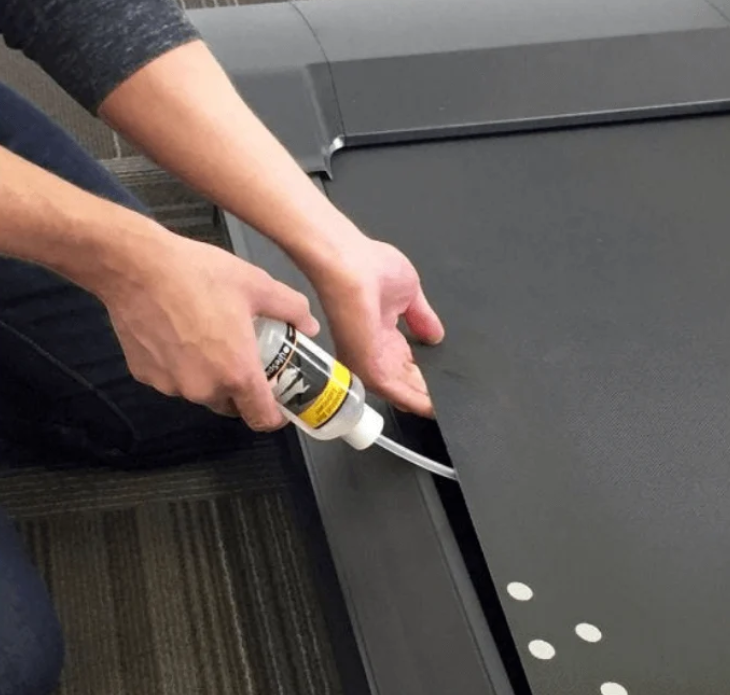
3. Lift the Walking Belt
You usually do not need to remove the walking belt.
Instead, gently lift one side of the belt away from the deck. You only need enough space to apply lubricant underneath the belt.
If the belt is difficult to lift, do not force it. Check the treadmill manual for the correct method.
4. Apply the Lubricant Under the Belt
Apply a small amount of treadmill lubricant underneath the walking belt.
Most treadmill manufacturers recommend a 100% silicone-based treadmill lubricant, but you should always follow the recommendation for your specific treadmill.
Apply the lubricant along the deck rather than directly onto the visible top surface of the walking belt.
A common approach is to apply lubricant in a thin line or according to the pattern recommended by the manufacturer. You do not need to soak the entire deck.
Too much lubricant is not better.
5. Repeat on the Other Side
Lift the other side of the walking belt.
Apply the recommended amount of lubricant underneath this side as well.
Try to distribute the lubricant across the area where the belt contacts the deck.
The goal is to create a thin layer that reduces friction between the belt and deck.
6. Run the Treadmill at Low Speed
After applying the lubricant, plug the treadmill back in.
Start the treadmill at a low speed. Do not step onto the belt immediately.
Let the belt run for several minutes so the lubricant can spread underneath the belt.
If your treadmill manual provides specific instructions for distributing the lubricant, follow those instructions instead.
7. Check the Belt
Turn off the treadmill and inspect the walking belt.
Make sure there is no excessive lubricant on the top of the belt or around the sides.
If lubricant has reached the top surface, clean it carefully. A slippery walking belt can increase the risk of losing your footing.
How Often Should You Lubricate a Treadmill?
There is no single lubrication schedule that works for every treadmill.
The correct frequency depends on the treadmill model, how often you use it, the type of belt and deck, and the manufacturer’s recommendations.
Some treadmills may need lubrication after a certain number of hours of use. Others may use materials designed to require little or no lubrication.
If you use your treadmill frequently, regular maintenance becomes more important.
The best approach is to check the owner’s manual first. Do not automatically lubricate the treadmill every month unless the manufacturer recommends it.
What Type of Lubricant Should You Use?
For many treadmills that require lubrication, 100% silicone treadmill lubricant is commonly recommended.
However, you should not assume that every lubricant is suitable for every treadmill.
Avoid using household oils, motor oil, cooking oil, WD-40, or other products unless your treadmill manufacturer specifically recommends them.
The wrong lubricant can damage the belt or deck material. It can also affect how the belt moves.
Always choose a lubricant that is specifically designed for treadmill maintenance and matches your manufacturer’s instructions.
Signs Your Treadmill May Need Lubrication
Your treadmill may show several signs when maintenance is needed.
The belt may feel less smooth than usual. You may also hear squeaking, rubbing, or other unusual sounds.
Another sign can be increased resistance when the belt moves. The treadmill motor may also appear to work harder than normal.
However, these symptoms do not always mean the treadmill needs lubricant.
A loose belt, worn walking belt, damaged deck, dirty components, or motor problem can cause similar symptoms.
If lubrication does not solve the problem, check the owner’s manual or contact the manufacturer or a qualified technician.
Common Mistakes When Applying Treadmill Lubricant
Using Too Much Lubricant
One of the most common mistakes is applying too much lubricant.
A large amount of lubricant does not necessarily provide better protection. Excess lubricant can spread beyond the deck and make the belt slippery.
Use only the amount recommended by the manufacturer.
Using the Wrong Product
Do not use random oils or household lubricants on your treadmill.
The belt and deck are designed to work with specific materials. Using an unsuitable product may cause damage or affect performance.
Applying Lubricant to the Top of the Belt
Treadmill lubricant generally belongs between the walking belt and deck when the treadmill requires belt lubrication.
Do not intentionally apply lubricant to the top walking surface.
A slippery walking surface can be dangerous.
Forgetting to Unplug the Treadmill
Always turn off and unplug the treadmill before working underneath the belt.
This simple step can reduce the risk of accidental startup while you are performing maintenance.
Ignoring the Manufacturer’s Instructions
Not every treadmill requires the same maintenance.
Some modern treadmills may have special belts or decks that do not require traditional lubrication.
The manufacturer’s instructions should always take priority over general advice.
How to Tell If Your Treadmill Is Properly Lubricated
After lubrication, the treadmill should run smoothly.
The belt should move without excessive friction or unusual noise. It should also remain properly centered and tensioned.
Do not expect the belt to feel extremely slippery. The goal is to reduce friction between the belt and deck, not to make the walking surface slippery.
If the treadmill still makes unusual sounds or the belt does not move properly, lubrication may not be the real problem.
Can You Lubricate a Treadmill Without Moving the Belt?
Yes, in most cases you do not need to remove the walking belt.
You can usually lift the belt slightly and apply lubricant underneath it.
However, the exact method depends on the treadmill design.
If you cannot safely access the deck, consult the owner’s manual instead of forcing the belt upward.
Does Lubricating a Treadmill Make It Run Better?
Proper lubrication can help reduce friction between the walking belt and deck on treadmills designed to be lubricated.
This may help the treadmill run more smoothly and reduce unnecessary stress caused by excessive friction.
However, lubrication cannot fix every treadmill problem.
If the belt is damaged, improperly tensioned, misaligned, or worn out, lubrication alone will not solve the issue.
Regular cleaning, belt inspection, proper alignment, and other recommended maintenance are also important.
FAQ
How often should I lubricate my treadmill?
The recommended schedule depends on your treadmill model and how often you use it. Check the owner’s manual for the manufacturer’s recommended interval. Some treadmills require little or no lubrication.
What is the best lubricant for a treadmill?
For treadmills that require lubrication, 100% silicone treadmill lubricant is commonly recommended. However, always use the product specified or approved by your treadmill manufacturer.
Can I use WD-40 to lubricate my treadmill?
It is generally not recommended to use WD-40 as a treadmill belt lubricant unless the manufacturer specifically says it is suitable. Use a treadmill lubricant designed for the belt and deck instead.
Can I use regular oil on a treadmill?
You should not use cooking oil, motor oil, or other household oils unless your treadmill manufacturer specifically recommends them. The wrong product can damage the belt or deck.
How much treadmill lubricant should I use?
Use the amount recommended by your treadmill manufacturer. Applying too much lubricant can make the belt slippery and cause excess lubricant to spread around the treadmill.
Should I run the treadmill after applying lubricant?
Usually, running the treadmill at a low speed for a short period helps distribute the lubricant underneath the belt. Follow the specific instructions in your treadmill’s owner’s manual.
How do I know if my treadmill needs lubricant?
A treadmill may need maintenance if the belt feels less smooth, produces unusual friction-related noises, or seems to have increased resistance. However, these symptoms can also have other causes, so check the manufacturer’s maintenance instructions.
Conclusion
Knowing how to apply treadmill lubricant is a useful part of treadmill maintenance. The basic process is simple: turn off and unplug the treadmill, check the manufacturer’s instructions, lift the walking belt, apply the recommended lubricant underneath the belt, and run the treadmill at low speed to distribute it.
The most important rule is to use the correct lubricant and the correct amount. More lubricant does not always mean better performance.
Before lubricating your treadmill, always check the owner’s manual. If your treadmill does not require lubrication, follow the manufacturer’s maintenance instructions instead.
With proper maintenance, your treadmill can continue to provide a smooth and reliable workout for years.